FAQ
|
Andalucia is on Central European Time (CET), or Central European Summer Time (CEST) during the summer months, i.e. Greenwich Mean Time (GMT) +1 in winter and GMT+2 in summer.
Mealtimes tend to be a little later in Spain than in the rest of Europe: breakfast is continental style and is usually eaten between 8am and 10.30am. In restaurants, lunch is served between 1pm and 3.30pm, and dinner from 8.30 to 11pm. In any case, the majority of tourist establishments adapt their opening times to the European norm, and, in practice, it is normal for cafés and bars to offer all-day service, with tapas, combo dishes, baguettes and "raciones" (dishes to share) available at any time.
Opening times for shops is 10am-2pm in the morning and 5-8/9pm in the afternoon. Department stores are open continuously 10am-9/10pm. Shops and shopping centres open on Saturday mornings, although in larger cities it is becoming more and more common to see them open on Saturday afternoons and even on some Sundays and public holidays. It is worth mentioning that bars and nightclubs usually remain open until 3 or 4am at weekends.
Chemists open during normal shopping hours, although in larger cities it is becoming more common to find 24-hour chemists. In any case, outside normal opening times there are specific duty chemists open all night. There are lists showing duty chemists for the night placed in the doorway of all chemists in a town.
Museums and monuments are usually open all day and often close one day during the week, given that they tend to stay open on Saturdays, Sundays and public holidays.
Main Post Offices are usually open non-stop 8.30am-8.30pm Monday-Friday, and 9.30am-2pm on Saturdays, closing on Sundays and public holidays. Opening times for other Post Offices vary according to the type of office and where it is. Stamps can also be purchased in "estancos" (licensed tobacco shops).
In general, public bodies (consulates, embassies, town halls, etc.) are open to the public 8.30/9am-2/3pm, Monday-Friday.
The majority of banks open Monday-Friday, 8.30am-2/2.30pm. Only a few branches open on Saturday mornings. Throughout Andalucia there are cashpoints available 24 hours a day, most of which (Servired, 4B, etc…) offer international service.
|
|
|
To drive in Andalucia/Spain you must be 18 years old, and 21 years old to hire a vehicle. Regarding your driver’s license:
- If you are from an EU member state, Switzerland, Norway, Iceland or Liechtenstein, you only need your valid driver’s license.
- If you are from any other country you will require an International Driver’s License.
Tourists travelling in their own vehicles should be aware that a Temporary Registration Permit may be required. You can request this permit at Customs and it is valid for 6 months.
|
|
|
- To make a complaint, you are entitled to ask for the "Hoja de Reclamaciones" (claims form), which establishments and companies are legally obliged to have available to customers. These complaints are then presented at the corresponding Provincial Consumers’ Association.
- Non-EU residents can claim back I.V.A. (Value Added Tax) on purchases carried out in Andalucia. Spanish legislation states that the minimum amount spent in one establishment on the same day must reach 90.15 Euro in order to request a tax-free receipt. The refund must be requested at the establishment in question, showing corresponding proof of residence. Within the subsequent 3 months, the purchaser should present the receipt and the items purchased at Customs to be stamped, and he/she should then request the refund from one of the offices of the various management companies located at the main airports in Spain/Andalucia.
- According to European Community regulations, travellers may not bring foodstuffs of animal origin into Spain as part of their baggage, with the exception of powdered milk for children, in its original packaging. Other foodstuffs can be brought in, up to a maximum of 1 kg.
- The minimum legal age for the purchase and consumption of alcohol and tobacco is 18.
- In accordance with Spanish Act 28/2005 of 26 December and European regulations, smoking is prohibited in public buildings, healthcare and teaching centres, railways, maritime services and city transport services (except open-air), party or leisure venues with access permitted to under 18s, etc. Given the broadly restrictive nature of the Law, it is advisable to check with staff in the establishment in question before smoking.
- According to the current Bill regarding Administrative Jurisdiction, the purchase and consumption of alcohol is prohibited in the street and, in general, in other open spaces except those established by the Local Council in question.
|
|
|
 |
On national and local holidays, public transport systems run and you will find some museums, monuments, information offices, shopping centres, etc. open. However, these will often have special opening times and/or conditions, given that there may be activities taking place in the area at the same time (fairs, open-air celebrations, religious events, etc.), so you should find out in advance to plan your trip correctly.
- New Year: 1 January
- Epiphany: 6 January
- Andalucia Day: 28 February
- Maundy Thursday and Good Friday: date varies year to year (March-April)
- Workers’ Day: 1 May
- Assumption of the Virgin Mary: 15 August
- Columbus Day: 12 October
- All Saints’ Day: 1 November
- Spanish Constitution Day: 6 December
- The Immaculate Conception: 8 December
- Christmas: 25 December
|
|
|
|
Travelling to Andalucia is easy. Documentation required varies according to the country you com from.
If you are a citizen of any European Union member state, Switzerland, Norway, Iceland or Liechtenstein, you only need your National ID Card or valid passport. If you are under 18 and travelling on an ID card, this should be accompanied by permission from your father, mother or corresponding guardian.
If you are from one of the following countries: Andorra, Argentina, Australia, Brazil, Brunei, Bulgaria, Canada, Chile, Costa Rica, Croatia, El Salvador, USA, Guatemala, Honduras, Israel, Japan, Malaysia, Mexico, Monaco, Nicaragua, New Zealand, Panama, Paraguay, Republic of Korea, San Marino, the Vatican, Singapore, Uruguay or Venezuela, you need a valid passport to enter Andalucia/Spain, and you will be entitled to stay up to a maximum of 90 days.
If you come from another country, you should apply for a visa from the Spanish Consulate in your place of residence, according to criteria established by the EU. You will also need to present your passport.
Given that conditions may vary, we suggest that you contact the Spanish Embassy or Consulate to verify these requirements before you start your trip.
|
|
|
Andalucia has a predominantly warm, Mediterranean climate: mild winters with irregular precipitations, and dry, hot, sunny summers, which become more extreme as you move inland from the coast.
The average year-round temperature is approximately 18ºC, and there are more than 300 days of sunshine per year, with January being the coldest month and August the hottest.
The rich, varied biodiversity here means that in Andalucia you can go from the desert climate of Tabernas (Almería) to the snowy peaks of the Sierra Nevada Mountains (Granada) or the marshlands of the Doñana National Park (Huelva).
Average temperature
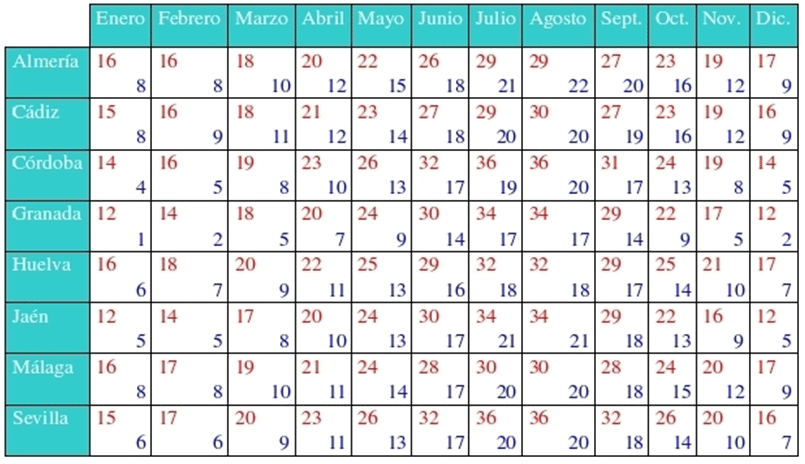
Average water temperature
Hours of sunlight per year

|
|
|
Andalucia is in the south of the Iberian peninsula. You can get to Andalucia by air, sea or land (car, train, bus or taxi).
- By air: In Andalucia there are 4 domestic airports (Almería, Cordoba, Granada and Jerez de la Frontera (Cadiz province)), and 2 international airports (Malaga and Seville) which offer flights to and from the main Spanish cities, and other overseas destinations, with Spanish and foreign airlines.
For further information, get in touch directly with the destination airport or the airline chosen for your trip.
- By sea: Andalucia has 836 km of coastline, with more than 30 marinas, 2 estuary ports, and 15 commercial ports. Special mention should be made of Algeciras Port (Spain’s largest in overall traffic), Malaga Port (the Iberian peninsula’s second busiest for cruise ships), Almería Port and Cadiz Port.
As well as travelling aboard a cruise liner, you can also get to these ports on scheduled services from Ceuta, Melilla, the Canary Islands and north African cities. Before travelling, it is advisable to get full details of routes and conditions from your travel agent or ferry/liner company.
1. By car:
The main road route into Andalucia is on the A-4/E-05 through the Despeñaperros Nature Reserve (Jaén province), although there is also good access on the A-92N in Vélez-Rubio and the A-7/E-15 in Huércal-Overa (Almería province), the N-433 in Rosal de la Frontera and the N-630 in Santa Olalla del Cala (Huelva province), the N-432 in Fuente-Obejuna and the N-420 in Cardeña (Cordoba province), etc.
All the different municipalities in Andalucia are connected by the National, Regional or Provincial Road Networks. The Cadiz-Seville section of the AP-4 and Malaga-Guadiaro section of the AP-7 are toll motorways, and there are other major motorways linking the main cities of Andalucia. It is important to remember that:
- The maximum speed limit for any vehicle is 120 kph, with lower limits on certain roads. You should always respect speed limits in each case.
- Use of seatbelts is obligatory for all passengers in motor vehicles.
- Use of helmets is obligatory when riding motorcycles, mopeds and bicycles.
- Telephones may only be used with "hands free" systems while driving.
- Children under 3 years must be strapped into a suitable seat for their weight and height.
- A reflective jacket must be used when getting out of the car on the road or the hard shoulder.
- If your car is stopped on the road or hard shoulder, use of warning triangles is obligatory.
- In general, the maximum alcohol level permitted is 0.5 g/litre in the blood, and 0.25 mg/litre of air (breathalyser).
Use of snow chains may be necessary, or you may find some road sections closed at certain times of year. This makes it advisable to plan your route correctly and check the state of roads with the "Dirección General de Traffico" (Highways Agency) before setting off.
In general, the historic centres of major cities can be covered on foot. Given the unusual urban layout of these areas, use of public transport services, rather than private vehicles, is recommended.
2. By train:
The Spanish National Railways Network (RENFE) offers a full range of services interconnecting the major cities of Andalucia and many smaller municipalities: there are Regional Services ("Cercanías") between many towns and villages in the provinces of Malaga and Cadiz, and Medium and Long Distance services throughout Andalucia and the rest of Spain. There is also a High Speed Service (AVE) to Cordoba, Seville and Malaga. There are special rates available for students, groups, over 60s, return tickets, etc. Contact RENFE or your travel agent for full information before setting off, and check conditions regarding transport of animals, bicycles or goods.
There are currently metro/underground building works underway in Malaga and Seville.
3. By bus:
There are many bus companies operating in Andalucia. They offer an extensive network of services with spacious, comfortable coaches, running to many towns and villages, some of which do not have rail services. These companies usually have an information and booking office at the main bus stations, or they have a customer service telephone number. It is advisable to contact the corresponding company in advance to check conditions on specific routes.
Within cities, there are municipal bus services running between different urban areas during the day, with a few special services by night. Single tickets cost around 1 Euro, and this is reduced if you purchase a Bonobús (card valid for 10 journeys) from the corresponding vending machines, or at "estancos" (licensed tobacco/stamp shops).
4. By taxi:
All cities in Andalucia have full taxi services offering urban and inter-urban transport at any time of the day or night. You can find taxi ranks in different areas of the city and at the main communications hubs (stations, airports, shopping centres, etc.). You can also order taxis by phone. Tariffs are fixed by the local council in question, and there are sometimes additional supplements payable in specific cases (nocturnal service, public holidays, etc.). You can request a receipt for the amount payable.
|
|
|
- "900" numbers and some emergency numbers are free of charge.
- National Police: 091
- Local Police: 092
- Guardia Civil: 062
- Emergencies: 112
- Ambulance: 061
- Fire brigade: 080
- Maritime Rescue and Safety: 900202202
- Regional Government of Andalucia, information: 902505505
- Youth Tourism Information (INTURJOVEN): 902510000
- Women’s Line: 900200999
- Child Line: 900506113
- Consumers’ Line: 900849090
- Healthcare Line: 902505060
- Post Office Information: 902197197
- AENA (Spanish airports) Information: 902404704
- RENFE – National Rail Services, Information and Bookings: 902240202
- RENFE – International Rail Services, Information and Bookings: 902243402
- Highways Agency (Dirección General de Tráfico (DGT)) – Roadside Assistance: 900123505
|
|
|
- In Andalucia/Spain we use the Metric (Decimal) System, with 7 basic units of measurement. This is also known as the International Unit System (SI), and governs all units of weight, measurement and distance.
- Tapas, a real institution in Andalucia. They are small appetisers which where originally served to cover ("tapar" – hence the name) glasses, thus avoiding dust getting into the drink. They are served in bars, cafés and restaurants, and are sometimes included in the price of the drink. "Raciones" are plates of one thing, larger than tapas.
- Andalucia has two regional television channels, Canal Sur and Canal Sur 2, and three radio stations, Canal Sur Radio, Canal Fiesta Radio and Radio Andalucía Información, offering all the latest regional news and information.
- The major national newspapers print a daily Andalucia section, although there are also local papers such as El Ideal in Granada, Diario Sur in Malaga and El Diario in Cordoba. They are available at newspaper kiosks; sometimes kiosks in major cities and certain tourist towns also sell international newspapers.
- When paying for bars, cafés, restaurants, hotels and taxis, it is common to leave a tip, in addition to the bill, or to round the total up, as long as you are satisfied with the service.
- There are a host of "locutorios" (shops to make cheap phone calls) and cyber cafés (with Internet connection at varying prices) to be found throughout Andalucia, and many tourist establishments also offer clients telephone and Internet services. There are also WIFI areas at airports and major railway stations.
- Although Catholic churches predominate in Spain, in large cities there are also places of worship from other religions, such as mosques, protestant churches, evangelical churches, Buddhist centres, Jehovah’s witnesses’ chapels, etc. For more information on this subject you should contact your religious community, either at home or at your destination.
- Although drinking bottled water is common in some coastal areas, the supply of safe drinking water from the tap is guaranteed throughout Andalucia.
|
|
|
- Hotel Bookings
- Golf Holidays
- Travel management
|
|
|
- Eventmanagement
- Catering
- Rent – a – cook service
- Interior Design
- VIP Maintainance
- VIP Security
|
|
|
- Accounting, Tax
- Business Set up
- Business to buy and sell
- Car rentals
- Golf resorts
- Interior Design
- Legal Support
- Office space for rent
- Luxury accommodation
- Real Estate buying and selling
- Relocation
- Rentals Long Term
- Secretaire Service
- Spa Hotels
- Sustainable Buildings
- Venues
|
|
|
| |
|







 OPENING HOURS

